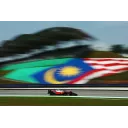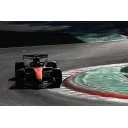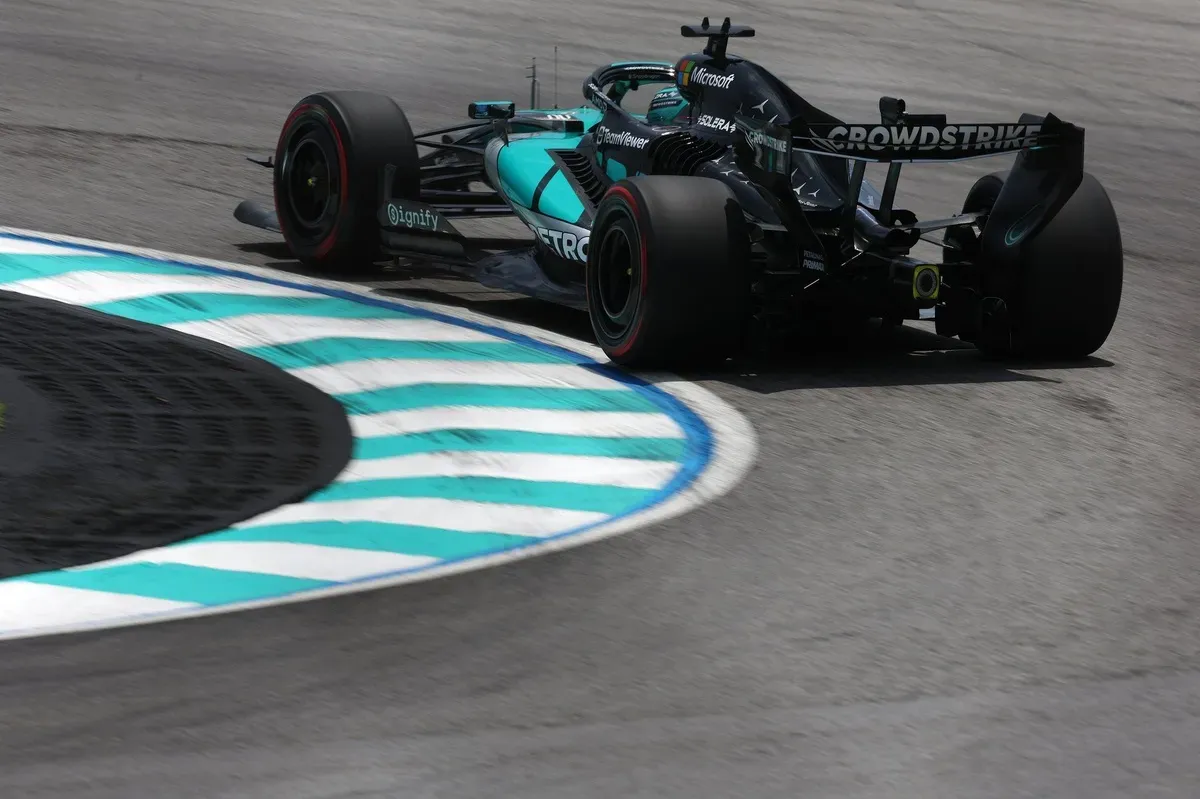
Friday practice for Formula 1's one-off return to Malaysia Grand Prix, following a nine-year hiatus, was always going to throw a few curveballs the paddock's way. But while Malaysia's daily monsoons missed the track, instead it was the Sepang circuit itself that proved tough to tame. Thursday's track walks had already indicated that the sandpaper tarmac, as Oscar Piastri described it, would lead to high tyre degradation. But conditions were even tougher than expected as the circuit started breaking up during practice, with organisers sending out sweeper trucks after FP2 to clear stones off the surface. Pirelli revealed one-lap runs on Friday were as much as 4.5 seconds slower than its qualifying simulations had anticipated because of the roughness and lower grip levels. "The conditions were not really good, the tarmac was breaking up," explained Pirelli's chief engineer Simone Berra. "We have some stones coming out and the FIA cleaned the track with the sweeper multiple times. The tarmac is degrading quite quickly, even during the session, so it's something that is not really under control at the moment. We were 4.5 seconds away from the simulations. We'll see tomorrow, but I don't think we are going to gain 4-5 seconds tonight. So yes, it's basically a matter of the tarmac conditions. We haven't run here for the last 10 years, so for the teams it was also difficult to have a proper reference."
Oscar Piastri
Berra stressed the track degradation, while likely only getting worse during the race, would not present a safety concern. "It's not a big issue in terms of safety, in terms of punctures. It's just a matter of generating a low grip level, because you have this high level of roughness," he said. "It could be even worse during the race, because you have all the cars running together with high temperatures, so I think it could end up that the tarmac will degrade quite a lot during the race. Honestly, it's not the end of the world, it's manageable, but for sure the grip level is not ideal." After finishing the day on top, Ferrari's Charles Leclerc said: "It's been a very, very difficult day overall. The track conditions were very, very tricky. Track was quite dirty, actually, and very slippery. So I think things will change and evolve a lot from today."

Liam Lawson
The high degradation on a lap per lap basis means that there may well be a discrepancy between the pecking order over one lap and over a full race stint, which could add strategy intrigue to a race on a circuit that is already lending itself to overtaking reasonably well. "It's a matter of finding a very good balance, not only for the car and the performance itself, but also in the long runs, try to keep consistency and keep the temperatures under control, to avoid any sliding or over-driving the tyres during the stint," Berra explained. "It could be the case that if you try to find the best balance for the race, you could end up with a temperature balance for qualifying. I've seen a couple of cases where teams had some difficulties switching on the front tyres. They didn't correctly set up the car to have the front ready for Turn 1 after the long straight after Turn 15. We could see some surprises, like some teams struggling more during qualifying, but then having a better performance for the race."
Source: Motorsport