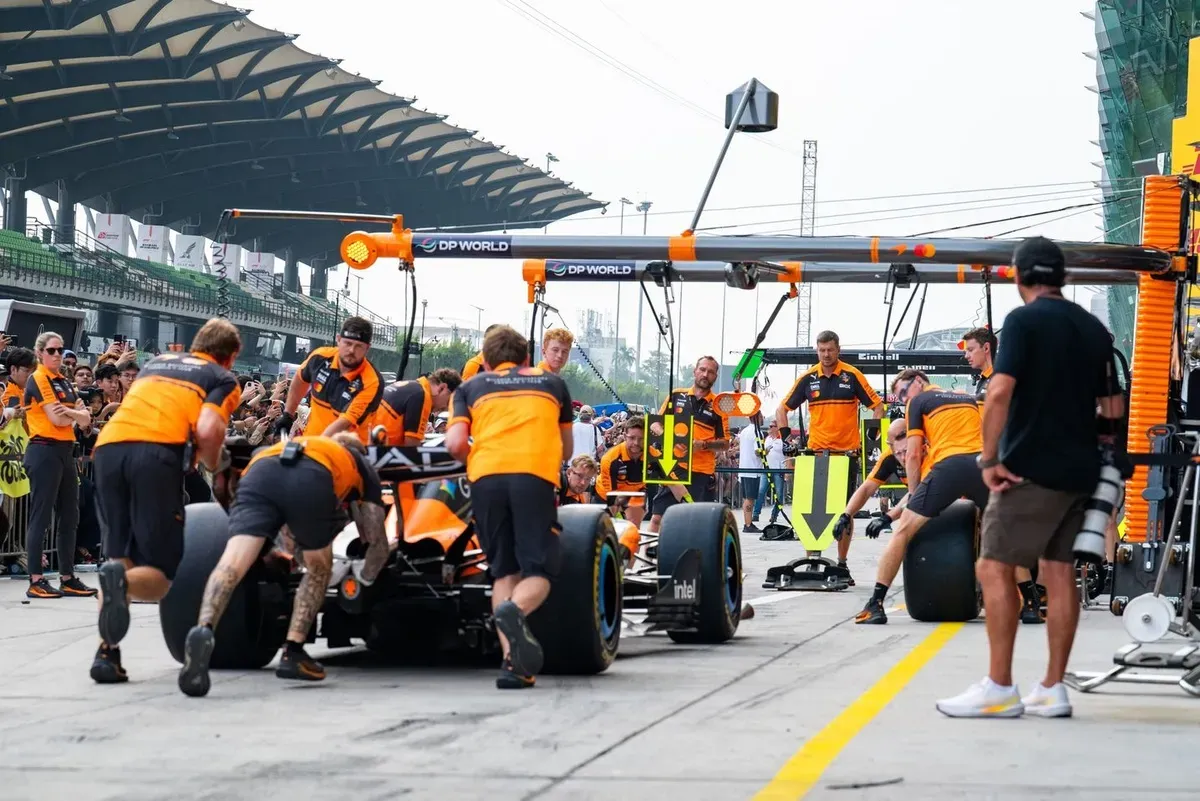
Malaysia's Sepang circuit is making a one-off return to the Formula 1 calendar as a proxy host for the Bahrain Grand Prix, bringing challenges both familiar and new. The hot and humid conditions, along with the daily late-afternoon rain downpour, act as a Proustian madeleine for those with previous experience of this venue. For others – including most of the drivers on the grid – these are conditions they have only read about.
Sepang occupies a significant place in F1 history since it signalled grand prix racing's aggressive expansion eastward under the Bernie Ecclestone regime. This was the first of many grand-scale facilities with statement architecture, paid for by governments who wanted to put their countries on the map. It also set the template for the kind of track designed by the architect who came as part of the package: Hermann Tilke. His belief was that wide tracks with long straights followed by sharp corners would facilitate overtaking organically by provoking drivers to make mistakes. Tilke's detractors describe his genre as bland and failing to deliver on the promise of overtaking.
The downside of state backing is that political winds change. In Malaysia, ticket prices set beyond the reach of most locals – just one would cost the average person's monthly wage – meant largely empty grandstands year-in, year-out. Not the advert the country wanted. In 2017, after 18 years as a fixture on the calendar, Malaysia terminated its hosting deal a season early.

Fans at Sepang
For Sepang's cameo appearance in 2026, the F1 cars are entirely different so there are many unknowns. Only the ambient heat and humidity, and the abrasiveness of the track surface, are well understood. At least one driver has likened the track surface to sandpaper. Built to withstand the harsh weather and provide quick drainage, the aggregate has a very open texture.
Tyres produce grip through a process known as hysteresis. Rubber is a viscoelastic material: unlike a fully elastic substance, it doesn't immediately spring back fully to its original shape once compression forces are removed. As a tyre rotates, the outer layer is compressed against the track surface and some of the kinetic energy is lost as heat as the material tries to return to its original state. The rougher the surface, the higher the temperatures. For this reason it's expected that tyre degradation will be more of a factor here than other tracks this season, coming as some relief after the Azerbaijan Grand Prix which was a nailed-on one-stop race.
Interestingly, while Pirelli has leaned towards the harder end of its compound family, it hasn't brought the hardest tyre of all. Instead the choices from hard to soft are the C2, C3 and C4 – just one step harder than in Baku. Sepang's layout, with long straights and sharp corners, is likely to be relatively deterministic in the way teams approach energy harvesting and deployment, potentially similar to the Chinese Grand Prix. But there are suggestions this may not actually be the case.
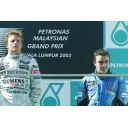
Fernando Alonso
"We come to an incredible circuit now," said Fernando Alonso, who claimed his maiden F1 pole position at Sepang in 2003. "It's going to be sad, the middle sector, because we cannot use the battery there – if not, you don't have enough charge for the three consecutive straights, you know, from Turn 14 to the last corner, then last corner to Turn 1, Turn 2 to Turn 4, you have to use the full 100% battery on those three straights, so the rest is just charging the battery."
So cars are likely to be quite slow through the middle sector – but anyone who uses electrical boost to snatch an overtake will pay for it at the end of the lap. When deploying the electrical motor, current cars put quite savage amounts of energy through the rear tyres, so the likelihood of damaging them by causing surface temperatures to spike is as worrying as thermal degradation.
"I think the big difference on this circuit compared with other so-called yo-yo circuits is the tyre overheating," said George Russell. "So circuits such as Melbourne, Silverstone, Monza, there wasn't actually that much tyre overheating from the surface. Canada as well. So that allowed drivers to stay a little bit closer within that one second. Even in Baku it was quite cool, drivers could stay close. Whereas here, surface overheating is going to be a huge thing. You'll be overheating tyres even on the outlap of a qualifying session, which may make it more challenging to follow closer and re-attack once overtaken. But that's a total unknown currently."
After several races with little or no degradation, this venue could generate some strategic variety, similar to the track which usually hosts the Bahrain Grand Prix, another rough surface hostile to tyre life. This may also be the first proper outing for F1's wet-weather tyres.
"It will be a good test for sure if it rains," said Carlos Sainz. "A good test for regulations also because I think with all the issues we have with downshifts, with harvesting, power, variability, corner to corner, the wet is going to be a challenge for sure. Both from a tyre standpoint – from what I heard from people that have run them, this year's wet tyre and inter-tyre are difficult – plus the power unit factor, it will be a good test."
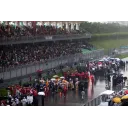
Rain at Sepang
In Malaysia you can reliably bet on a torrential downpour at around 4 o'clock in the afternoon. Sometimes it arrives early; sometimes it clears up quickly. But there are circumstances where it can be raining but, owing to the heat drying the surface, not wet enough even for intermediate tyres, as was the case in 2009.
"The only thing I remember from Japan is that the tyres have zero grip," said Isack Hadjar. "It would make the racing very dangerous with a lot of water. So, I would definitely welcome any competitive session to be a rain session and qualifying. But at the moment, for the race, with all this energy, I think it would create a bit of chaos. I don't think we're much ready for that. But definitely qualifying – why not?"
Source: Autosport